
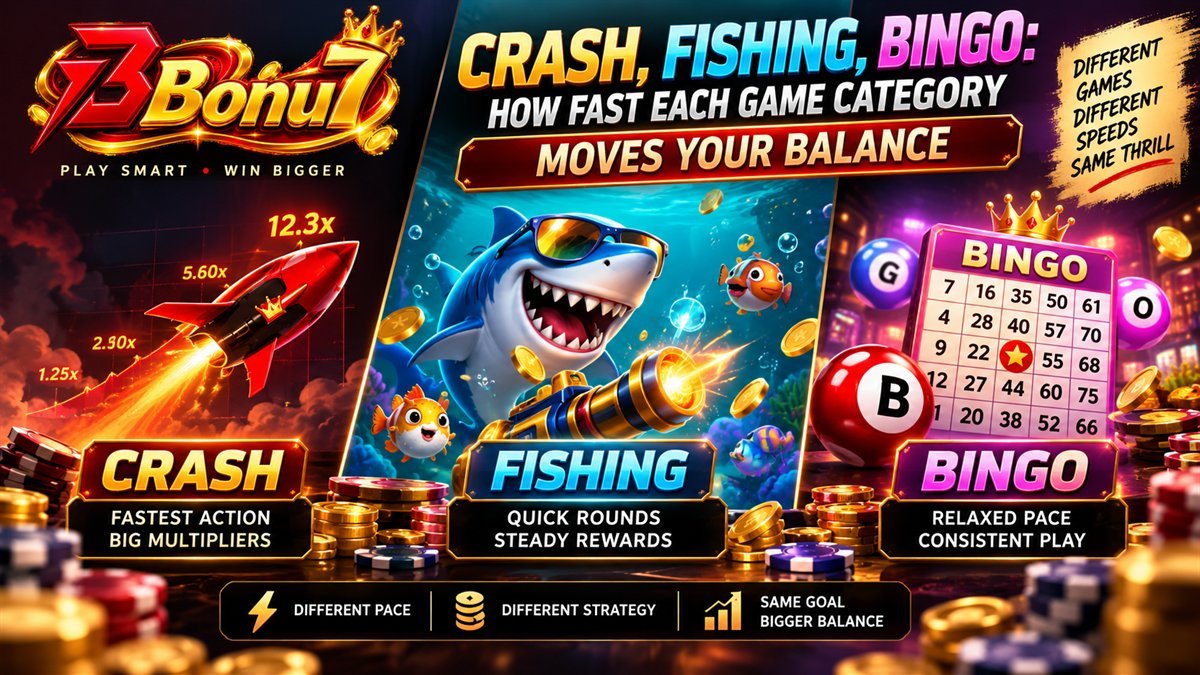
Key takeaways
- Pacing and house edge are independent. How fast a category lets you bet says nothing about how favourable each individual bet is.
- Originals and fishing arcade move fastest — seconds per round or per shot, with no dealer, reel animation or draw wait to sit through.
- Live casino and bingo are deliberately the slowest — both are paced by a real-time clock shared with other players, not by you.
- A fixed budget lasts longer, in play time, at a slower pace — the same money simply gets spread across more minutes.
- Wagering progress depends on pacing and weighting together, not pacing alone — see our welcome bonus guide for the weighting half of that equation.
Ask why one session felt like it evaporated in ten minutes while another stretched a similar deposit across an hour, and the honest answer is usually pacing rather than luck. Some game categories are built to resolve a round in the time it takes to read this sentence. Others are built to take several minutes per hand on purpose, because a real dealer is running a real table for several players at once. Neither is better — they are simply different tools, and picking the wrong one for what you actually want from a session is a very ordinary, very avoidable disappointment.
This article compares every category on bonu7 game by the one dimension that almost never gets discussed directly: how fast each one lets you place a bet, and what that speed actually does to a fixed budget and a fixed amount of time.
Pacing vs. edge — two different questions
It helps to separate two things that get bundled together in casual conversation but are mechanically unrelated. House edge is the average share of each stake a game keeps over a very large number of rounds — a property of that specific game. Pacing is simply how many opportunities to bet a format gives you per minute. A game can have a modest edge and a fast pace, a modest edge and a slow pace, or any other combination — the two numbers do not move together.
Why this matters practically: two players depositing the identical ₹1,000 can have completely different experiences depending only on pacing. One, playing a fast format, might place two hundred bets in twenty minutes. The other, playing a slow format, might place twenty bets in the same twenty minutes. Assuming similar stake sizes, the first player's budget is doing roughly ten times more "work" per minute — which changes how long the session lasts, how quickly a wagering requirement moves, and how much variance shows up within a given sitting, without saying anything at all about which player made the better choice.
Edge decides what a game returns on average over the long run. Pacing decides how quickly you find out. Choosing a category is really choosing a setting for the second dial, not the first.
Per round: crash, mines, plinko and the rest of Originals
The Originals category — crash, mines, plinko-style drop games, HILO, and similar formats — is built around the fastest possible round structure available. There is no reel to spin, no card to shuffle, no dealer pacing the table. You set a stake, the round resolves in seconds, and the next round can start the moment you choose to place another bet.
Crash is the clearest example of why this category moves quickly and why it still involves a real decision each round. A multiplier climbs from the moment the round starts, and you choose when to cash out before it "crashes" back to zero — the round itself takes only a few seconds, but you are making an active, time-pressured choice inside that window rather than just watching an outcome resolve. Mines and plinko remove the timing pressure but keep the same rapid round-to-round cadence: pick a risk level, commit a stake, see the result, repeat immediately if you choose to.
The practical effect is that Originals let you place more individual bets per minute than almost any other category, purely because there is so little non-betting time between one round and the next. That is a pacing fact, not a value judgement — some players want exactly that rhythm, and others find it too fast to enjoy.
Per spin: slots
Slots sit in the middle of the pacing scale. A spin resolves quickly — typically a couple of seconds for the reels to settle — but the category also includes bonus rounds, free-spin sequences and pick-style features that can pause the rapid spin-and-repeat rhythm for a noticeably longer stretch when they trigger. Base-game play alone is close to Originals in speed; a session that hits several bonus features runs meaningfully slower in practice, simply because those features take longer to play out than an ordinary spin.
Volatility and pacing are also easy to conflate here and worth separating explicitly. A slot's volatility describes how spread out its results are — how often it pays and how large those payouts tend to be relative to the stake — and says nothing about how many spins per minute you can play. A very high-volatility title and a very low-volatility title can both be spun at the same speed; what differs between them is the shape of the outcomes, not the tempo of play.
Per shot: fishing arcade
Fishing arcade titles use a staking model that catches new players off guard, and it is worth stating plainly because it is the single most important pacing fact about the category: every individual shot is staked, not every round. A "round" in a fishing game is really an open-ended session where you fire repeatedly at moving targets, and each shot you take costs a stake regardless of whether it hits anything.
This makes fishing arcade one of the fastest-moving categories on the platform, often rivalling or exceeding Originals, because a single minute of active play can easily involve dozens of individual staked shots rather than dozens of resolved rounds. A player used to thinking in terms of "spins" or "rounds" can burn through a budget far faster than expected here simply by not realising that the counting unit has changed from round to shot.
Per hand: live casino & table games
Live casino tables — real dealers, physical cards or a physical wheel, streamed to every seated player — are paced by a real-time betting clock rather than by any individual player. A hand of blackjack, a round of baccarat or a spin of a live roulette wheel takes as long as it takes for the dealer to actually deal cards, resolve bets and pay out, typically on the order of a minute or more per resolved round once betting time, dealing and payout are all included.
This is a deliberate design feature, not a limitation. A physical dealer running a table for a shared pool of players cannot resolve hands at the speed of a solo RNG round — nor would most players who choose live tables want it to, since the appeal of the category is largely the realism and social pacing of an actual casino table. RNG-resolved card & table titles that are not live-streamed move considerably faster, since they remove the human dealer and the shared-table waiting time while keeping the same card-game structure.
Live tables are the one category where your pacing is not fully your own choice — it is set by the dealer and the other seated players, which is the whole point of the format.
Per ticket: bingo & numbers
Bingo & numbers formats — draw-based games where numbers are called and matched against a ticket — are the most passive category on the platform in terms of in-round decision-making, and among the slowest in terms of raw pacing. A draw takes real time to call its full sequence of numbers, and unlike Originals or fishing, you generally cannot compress that time by playing faster; the draw resolves on its own schedule regardless of how quickly you would like the next one to start.
What you can typically speed up is how many tickets you hold within a single draw — buying multiple tickets for the same draw increases your stake for that draw without needing the draw itself to move any faster. This makes bingo pacing unusual compared to every other category on this list: your total stake per unit time is adjustable, but the clock that governs how many draws happen per hour largely is not.
The full comparison, side by side
Putting all five staking models next to each other, from fastest to slowest. Treat every figure here as an illustrative band for comparison, not a specific claim about any one title — actual pacing varies by game, by your own play speed, and for live formats, by how many other players are seated at the table.
| Category | Staking unit | Relative pace | What paces it |
|---|---|---|---|
| Originals (crash, mines, plinko) | Per round | Fastest | You — no dealer or draw wait |
| Fishing arcade | Per shot | Fastest | You — fire rate and reflexes |
| Slots | Per spin | Fast, slower during features | Mostly you; bonus rounds add pauses |
| Card & table (RNG) | Per hand | Moderate | You, paced by game's own animation |
| Sports & fantasy | Per contest | Slow — tied to real fixtures | The real-world match schedule |
| Live casino | Per hand | Slowest | The dealer and the shared table |
| Bingo & numbers | Per ticket, per draw | Slowest | The draw's own schedule |
Notice that "slowest" appears twice for genuinely different reasons: live casino is slow because a human dealer is running a real table, while bingo is slow because a draw has its own fixed schedule that no player can accelerate. Both produce a similar practical outcome — fewer bets per hour — by entirely different mechanisms.
Why pacing matters for wagering
If you are working through an active bonus, pacing is one half of how quickly a wagering requirement clears — and it is easy to overweight, because it is the half you can feel directly while playing. Our welcome bonus guide covers the other half in depth: contribution weighting, which decides what percentage of each staked rupee actually counts toward the requirement.
The two combine multiplicatively, not independently, which is the part that catches people out. A fast-paced category weighted at a low percentage can clear a requirement more slowly, in real time, than a slower-paced category weighted at 100% — because pace determines how much you stake per hour, and weighting determines how much of that staking actually counts. Fast plus low-weighted is not a shortcut; it can be the worst combination on the table.
Matching pacing to your budget and time
Outside of any bonus, pacing is really a question about what you want out of a session, and there is a genuine, honest trade-off rather than a single right answer.
| If you want… | Pacing tends to suit |
|---|---|
| A long session on a modest budget | Slower-paced categories — live casino, bingo — spread the same money across more minutes |
| Rapid rounds and quick decisions | Originals and fishing arcade — a stake resolves in seconds, again and again |
| A social, table-style atmosphere | Live casino — the pacing is part of what people come to this category for |
| Minimal in-round decision-making | Slots and bingo — watch the result resolve rather than actively choosing each step |
| A short session that still feels full | Fast categories fit more resolved outcomes into a fixed window of time |
None of these are rules — they are starting points for matching a category to what you are actually looking for from the time you have set aside, rather than discovering the mismatch twenty minutes into a session.
A worked example: ₹1,000, five ways
Round numbers, chosen for clarity rather than as a claim about any specific title. Same deposit, same average stake per bet, five different categories, to show how differently the same budget can play out purely because of pacing.
| Category | Illustrative bets per minute | Rough session length |
|---|---|---|
| Fishing arcade | High — many shots per minute | Shortest |
| Originals | High — a round every few seconds | Short |
| Slots (base game) | Moderate-high | Short to moderate |
| Card & table (RNG) | Moderate | Moderate |
| Live casino | Low — one hand roughly per minute or more | Longest |
The identical ₹1,000, at a similar average stake, can plausibly last anywhere from a handful of minutes to well over an hour depending purely on which category it is spent in — before any consideration of how the results themselves land. That difference is the entire subject of this article: pace decides how long the money is in play, not whether the game is a good one.
How to actually choose
Four honest questions, in order, cover most of what deciding on a category actually comes down to.
- What do you actually enjoy? Pacing should follow enjoyment, not the other way round. A fast category you find stressful is not a better choice than a slower one you find relaxing, even if the fast one theoretically "does more" with the same money.
- How much time have you actually set aside? A slower category matched to a short window ends abruptly and unsatisfyingly; a faster category matched to a long window can burn a budget before the window is even half used. Match the two roughly.
- Is a bonus active, and what is its weighting? If so, cross-check pacing against the promotion's weighting table before assuming a fast category clears the requirement efficiently — see the section above.
- Have you set a limit either way? Whatever the category, decide the budget and the time before you start, not while you are already in the middle of an engaging session. This matters more at faster paces, where more decisions get made per minute and there is less natural pause to reassess.
Frequently asked questions
Which game category moves a balance the fastest?
Originals such as crash, mines and plinko are generally fastest, since each round resolves in seconds with no reel, dealer or draw wait. Fishing arcade moves almost as fast, because every individual shot is staked rather than every round. Live casino and bingo are the slowest by design, paced by a real-time clock shared with other players.
Does a faster-paced game increase the house edge?
No. Pacing and house edge are unrelated — a fast format simply lets you place more bets per hour. The edge on each individual bet comes from that specific game, not from how quickly rounds resolve.
Why does my wagering progress move faster on some games than others?
Two factors combine: bets per hour, and the contribution weighting of that category. A fast category weighted low can clear a requirement more slowly than a slower category weighted at 100% — check both figures, not pace alone. Our welcome bonus guide covers weighting in full.
Is a slower-paced game a safer choice for a small budget?
Often, in the sense that fewer bets per hour spreads a fixed budget across a longer session. It does not change the house edge or the odds of losing the budget entirely — only how long that budget tends to last in play time.
Should I pick a game category based on speed alone?
No. Enjoyment, how much decision-making you want, your budget, and any active bonus's weighting all matter too. A fast game you do not enjoy is a worse session than a slightly slower one you do, for identical money.